


When is the golden window to regenerate the lead-acid batteries?
Q: How does the PRIME Regenerator reliably extend lead-acid battery life by 2 to 3 times—and how does it differ from conventional restoration claims?
A: Genuine battery regeneration is not about attempting to revive expired cells; it is proactive preventive maintenance applied at the precise "Golden Window."
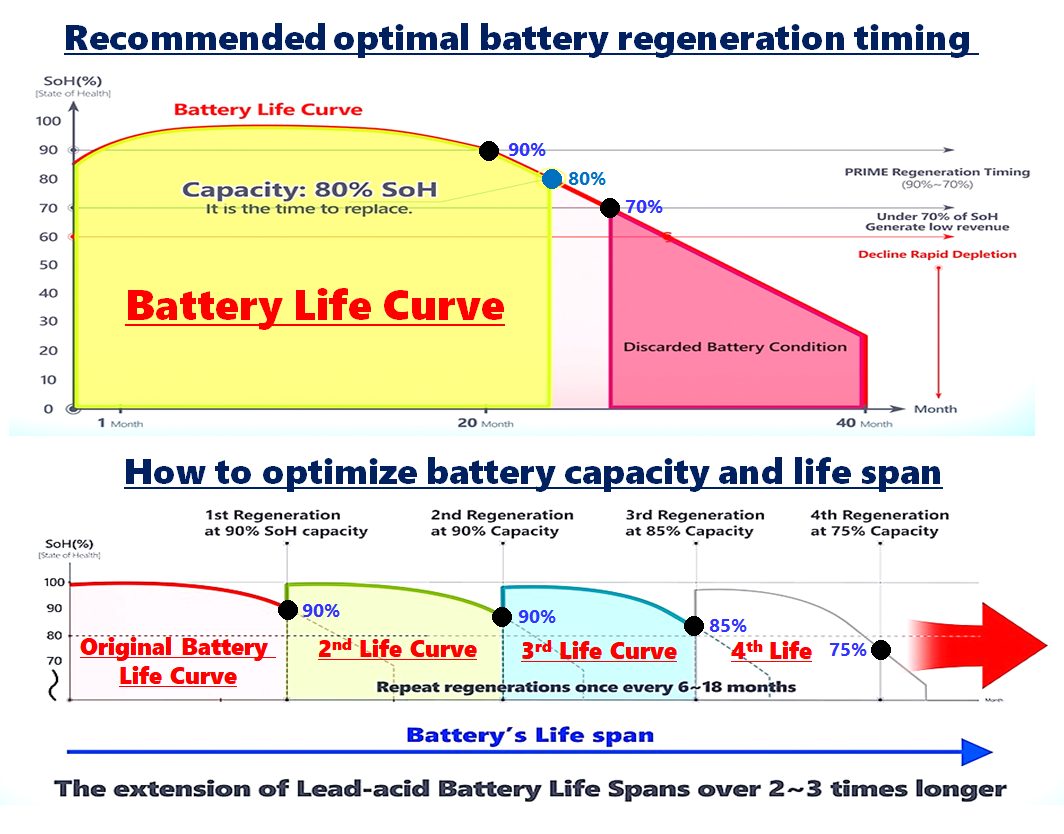
Throughout lead-acid batteries' 120-year commercial history, achieving true lifespan extension has remained an engineering challenge. Today, the market features a wide spectrum of devices—from low-cost consumer units to heavy commercial cabinets—promising complete desulfation. Yet field operators consistently encounter disappointment. The core issue is failing to respect lead-acid chemistry's electrochemical and physical limits.
The engineering principles behind authentic regeneration are clear:
1. Reviving fundamentally degraded batteries is ineffective. Once a cell suffers extensive plate corrosion, active material shedding, electrolyte discoloration, and severe internal resistance, no external process can reverse that structural breakdown. A meter may show an exhausted battery rising from 50% SoH to 80%, but in terms of cycle life, it yields barely 10% usable operation before rapid decline sets in. Mechanically failed batteries are simply not viable engineering.
2. High-voltage equalization causes destructive internal heat. Conventional restoration devices typically rely on high-voltage overcharging to break up hardened sulfate crystals. This inevitably generates severe internal heat, permanently degrading the plate grids and accelerating failure.
-
Voltage readings can be deceptive: An elevated terminal voltage immediately following a charge does not prove restored capacity.
-
A non-thermal process is essential: The true benchmark is dissolving crystalline lead sulfate without thermal stress.
-
Proof through discharge testing: True verification requires an official Constant Current Discharge Test, measuring actual runtime directly against baseline factory specifications.
3. Success depends on "Golden Window" preventive maintenance. Just as industrial equipment gets scheduled fluid changes long before mechanical seizure, battery regeneration must happen while the cells are still in active, healthy service.
-
The Golden Window Timeline: Apply regeneration when the State of Health (SoH) drops to 90%–85% across 2–3 intervals, followed by 2–3 subsequent treatments as SoH reaches 85%–80%—representing 5 to 6 total preventive cycles over the pack’s operational life.
-
PRIME Pulse Function: It dissolves fine crystalline deposits without heat, restores electrolyte specific gravity, and rebalances cell impedance across the entire bank.
-
Documented Lifespan Results: Extends service life by 2x for 12V batteries, 2x to 2.5x for 6V/8V units, 2.5x to 3x for VRLA lines, and over 3 times for 2V industrial deep-cycle systems.
One-Touch Fully Automated Operation: The operational procedure is streamlined: enter the bank's nominal voltage (V) and rated capacity (Ah), then press START. The PRIME system independently manages cell balancing and non-thermal regeneration through completion. Incorporating one scheduled PRIME treatment per year significantly delays capital replacement cycles and delivers measurable reductions in total cost of ownership (TCO).